What is document format
Document format (thể thức văn bản) is the set of parts that make up a document: the main parts that apply to every type of document and the additional parts used in specific cases (Article 8, clause 1, Decree 30/2020/ND-CP).
Layout rules cover paper size, page orientation, margins, font, font size, font style, the position of each part and page numbers (Article 9). The detail is in Appendix I; capitalization follows Appendix II; type abbreviations follow Appendix III.
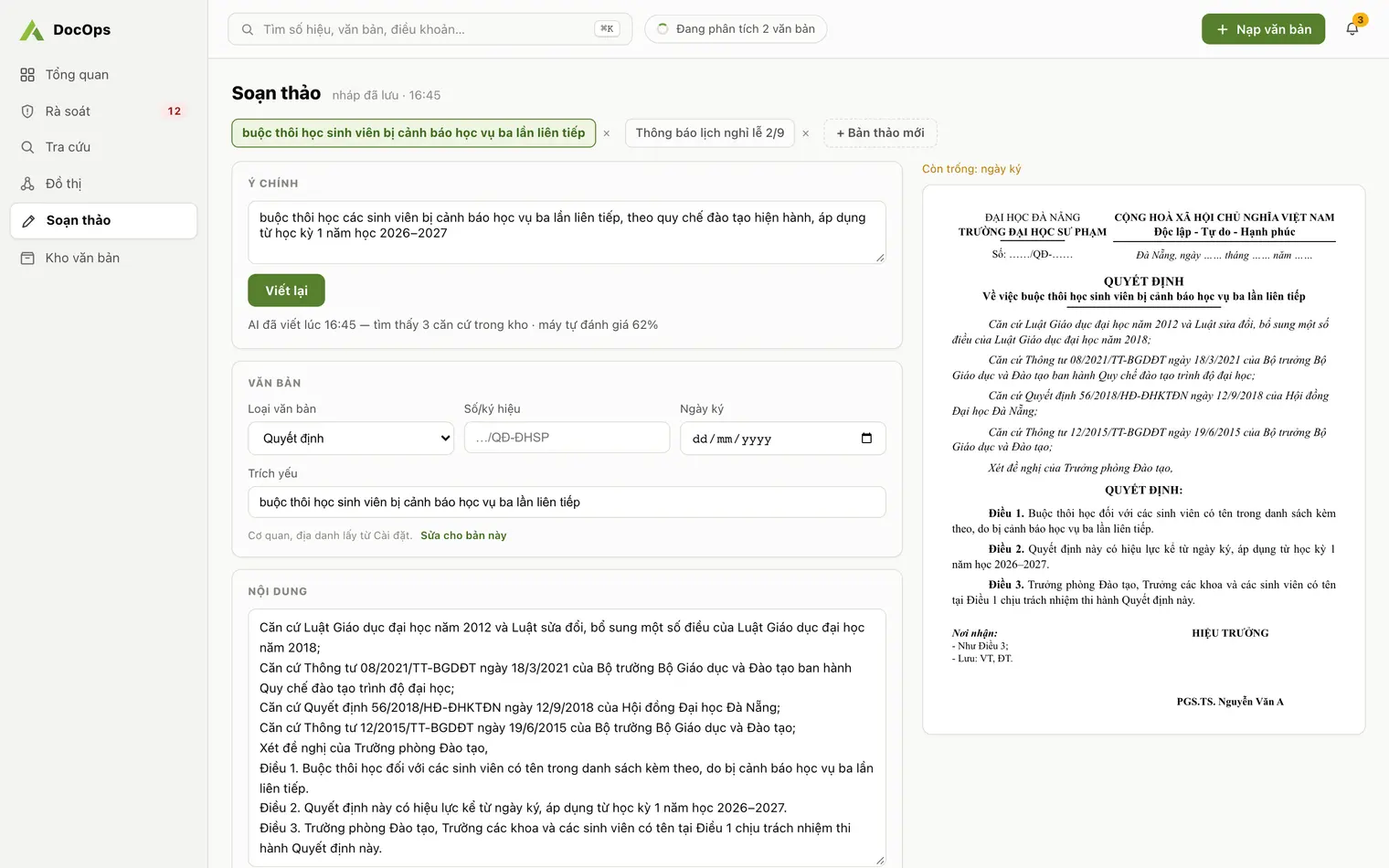
Layout rules in Appendix I
| Element | Rule |
|---|---|
| Paper size | A4 (210 mm x 297 mm), portrait |
| Top and bottom margins | 20–25 mm |
| Left margin | 30–35 mm |
| Right margin | 15–20 mm |
| Font | Times New Roman, Unicode character set TCVN 6909:2001, black |
| National Title (Quốc hiệu) | Capitals, size 12–13, upright, bold |
| Motto (Tiêu ngữ) | Lower case, size 13–14, upright, bold, underlined with a line as long as the text |
| Issuing body name | Capitals, size 12–13, upright, bold, underlined with a line 1/3–1/2 the length of the text |
| Number and reference code | Size 13; “Số” in lower case, reference code in capitals |
| Place and date | Lower case, size 13–14, italic |
| Document type name | Capitals, size 13–14, upright, bold |
| Summary | Lower case, size 13–14, upright, bold; in an official letter it follows “V/v”, size 12–13 |
| Content | Lower case, size 13–14, justified, first-line indent 1 cm or 1.27 cm, at least 6pt between paragraphs, line spacing from single to 1.5 lines |
| Signing authority and position | Capitals, size 13–14, upright, bold |
| Signer’s name | Lower case, size 13–14, upright, bold |
| Recipients (Nơi nhận) | “Nơi nhận:” size 12, italic, bold; the list size 11, upright |
| Page number | Size 13–14, centred in the top margin, not shown on the first page |
The nine main format parts
- National Title and Motto: at the top right of the first page. The National Title “CỘNG HÒA XÃ HỘI CHỦ NGHĨA VIỆT NAM” is in capitals, size 12–13, bold. The Motto “Độc lập - Tự do - Hạnh phúc” is in lower case, size 13–14, bold, centred under the National Title and underlined with a line as long as the text.
- Name of the issuing agency or organization: the full official name, plus the name of the directly supervising body if there is one. The issuing body’s name is in capitals, size 12–13, bold, underlined with a line 1/3–1/2 the length of the text.
- Number and reference code: the number is the sequence number within the year, registered at the records office; numbers below 10 get a leading 0. The code joins the type abbreviation to the body’s abbreviation, size 13. The abbreviations are listed on Administrative document types.
- Place and date of issue: lower case, size 13–14, italic, on the same line as the number and code. A comma follows the place name; days below 10 and months 1 and 2 get a leading 0.
- Type and summary: the type name is in capitals, size 13–14, bold; the summary is in lower case, size 13–14, bold, right under the type name. An official letter writes its summary after “V/v”, in lower case, size 12–13.
- Content: lower case, size 13–14, justified, first-line indent 1 cm or 1.27 cm, at least 6pt between paragraphs, line spacing from single to 1.5 lines.
- Position, name and signature of the authorized person: the signing authority is written TM., Q., KT., TL. or TUQ. The authority and position are in capitals, size 13–14, bold; the name is in lower case, size 13–14, bold, with no academic title or degree before it, unless the head of the sector rules otherwise for armed forces and for education, health and science public-service bodies.
- Seal or digital signature of the body: on an electronic document this is a red seal image at real size, as a transparent-background .png, overlapping about 1/3 of the authorized person’s digital signature image on its left side.
- Recipients: “Nơi nhận:” is size 12, italic, bold; the list is size 11, upright; the last line reads “Lưu: VT” followed by the drafting unit and the number of copies.
Additional parts
- Appendix: attached to the document when needed (Article 8, clause 3, point a).
- Confidentiality, urgency and circulation marks: urgency levels are hỏa tốc, thượng khẩn and khẩn; confidentiality levels are tuyệt mật, tối mật and mật; circulation notes include “XEM XONG TRẢ LẠI” and “LƯU HÀNH NỘI BỘ”.
- Drafter’s code and number of copies issued: an additional part under Article 8, clause 3, point c: the drafter’s code and the number of copies issued.
- Address, email, website, phone and fax of the body: an additional part under Article 8, clause 3, point d: the body’s address, email, website, phone and fax number.
Checklist before signing
- The National Title and Motto are spelled correctly and the Motto has its hyphens.
- The supervising body and the issuing body are named exactly as officially registered.
- The number was issued by the records office at registration and the reference code uses the right type abbreviation.
- A comma follows the place name; days below 10 and months 1 and 2 have a leading 0.
- The summary is short and reflects the main content.
- The legal bases are still in force; the first citation gives the type, number, code, date, issuing body and summary in full. How to review them is covered on Legal basis review.
- The signing authority is right: TM., Q., KT., TL. or TUQ.
- The recipient list is complete and ends with “Lưu: VT”.
- Margins, font and sizes match the layout table above.
How DocOps checks format
For documents already ingested into the repository, DocOps checks nine items: National Title, Motto, issuing body name, number and code, place and date, type and summary, recipients, signature and seal. The National Title and the Motto are separate items and the content is not graded, so the count differs from the nine parts in Article 8. Each item is marked pass, missing or needs review; the overall result is pass, needs review or fail. AI does the grading and staff review the result.
DocOps does not measure the margins, font or font size of a file.
- Drafts written by DocOps follow the Decree 30 template, see Decree 30 document drafting.